Released Inmates in Greenville, SC can be tracked through an up‑to‑date inmate release list that shows recently released inmates, their case numbers, and release dates. The online inmate release date search pulls data from the parole release database and released prisoner records, presenting a clear jail release roster for families and attorneys. By using the released inmate lookup feature, users quickly confirm release from custody and verify the release date without sifting through paperwork.
For those needing more than a name, the system offers post‑release monitoring details, release status check, and released inmate contact info when available. Users can also explore released inmate mugshots, parole eligibility list, and recent inmate releases to understand prison release statistics. The platform supports release date verification, released inmate location tracking, and links to released inmate assistance programs, helping families navigate reintegration and community resources.
How to Search Released Inmates
Released inmates can be checked through Greenville County’s official inmate search page. The search can help you match a person’s name, booking or case number, release date, and custody status. Users can also reference current inmates for additional information. It matters because a release date may arrive before the public list changes, and one name may match more than one person. Use the steps below to check the county record, then confirm any court-related result with the court or agency named in the record.
Official Search Portal: https://greenvillecountysc.gov/disclaimer/InmateSearch.aspx
Steps to Search
- Open the official portal above. The page may show a disclaimer or send you to the county’s inmate search form. Read the disclaimer and follow its instructions before entering any search terms.
- Enter the person’s full legal name using the format requested by the form. If the form asks for separate first and last name fields, check both fields for spelling and spacing.
- Add a booking number or case number when the form provides a field for one. A booking number identifies a stay in custody, while a case number identifies a court case. Searching with both can reduce the number of matching people.
- Set a release or custody date filter if one appears. For today’s listing, use October 23, 2026. If the form has no date control, leave the date fields empty and review each matching record by hand.
- Submit the search and wait for the result list. Look for the person’s name, booking number, case number, release date, release type, and facility. Do not rely on the first name match alone.
- Compare the search result with any details you already have. A matching date alone can be weak evidence because several people may leave custody on the same day. A booking number, case number, or date of birth provides a stronger match.
- Review the source named for the record. A county listing can show a change in jail custody, but the court docket controls the case result. State parole and supervision records come from the South Carolina agency or office named in the release entry.
- Record the date and time of your search, especially for a recent release. Check the portal again later if the record changes, since corrections can appear after the first posting.
A clean search record should keep the name, identifiers, release date, and source separate. That makes it easier to spot a typo, compare a later correction, and avoid mixing two people with the same name.
Release Record Details
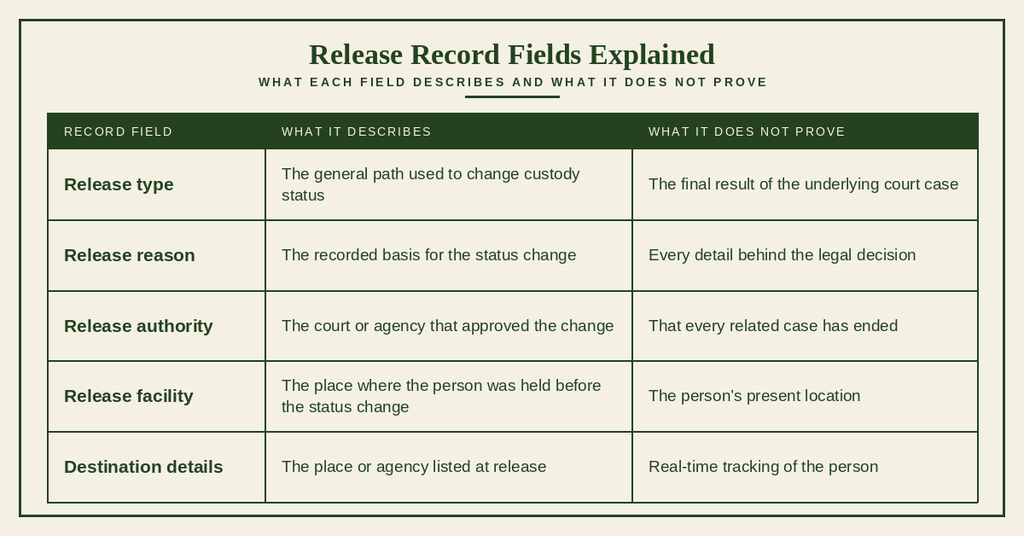
A release record describes one custody change. It does not tell the full story of a court case, a person’s current address, or every condition that follows release. Read the fields below as parts of a larger record and compare them with the proper case, parole, or court source.
Release Type
The release type is the short category assigned to the custody change. Common categories include bond, sentence completion, court order, case-related release, and transfer. Some systems group parole, medical release, or other approved actions under one general label. Read any code key or disclaimer on the portal so that you interpret the label in the same way as the county.
Release Reason
The release reason explains the basis for the status change. It may refer to posted bond, a completed sentence, a court order, or the resolution of a case. Some entries use brief internal codes instead of full sentences. A code such as “case closed” may be too broad for a legal question, so check the case docket before drawing a conclusion about charges, sentences, or appeal rights.
Release Authority
The release authority identifies the court or agency responsible for approving the change. County detention staff handle many jail releases. A state court can order a release, and state corrections or parole authorities handle some people held for state sentences. The named authority should fit the release type. A mismatch may mean the entry was copied incorrectly, the record changed, or the status covers a different legal event.
Court, county, and state roles
Each system answers a different question. The jail roster shows custody status. The court docket shows charges and case decisions. The South Carolina Department of Corrections or South Carolina Board of Corrections can confirm state release and parole matters when the record points to state custody. Using the right source prevents a jail transfer from being mistaken for a return to the community.
Release Facility
The release facility names the facility that held the person before the recorded status change. Match that name with the booking details and the county or state authority. A transfer entry often names two facilities: the sending location and the receiving location. The sending facility is not the person’s current destination. For a search result tied to a county booking, Greenville County may appear as the facility, but the exact label should come from the record itself.
Release Destination Details
Destination details may show a home address, another facility, a court, a treatment program, or no public destination. These fields should not be treated as a current address or a tracking tool. Released inmate location data can change soon after release, and many destination fields are withheld for safety or privacy. If post-release monitoring applies, contact the supervising agency named in the court or release record.
Types of Inmate Releases
Different release types carry different legal meanings. A person can leave jail after posting bond, finish a sentence, receive a court order, or move to another facility. The jail release roster may list all of these under one status page, so check the type and reason before drawing conclusions.
Bond Release
Bond release means the person left custody after the required bond or promise to appear was posted. This can happen before trial or after a conviction. The posting shows that a release condition was met, but it does not erase the charge or decide the case. If bail details appear on another court record, compare the amount and conditions with the release entry. A bail status should not be confused with proof that a case has been dismissed.
Sentence Completion
Sentence completion means the stated jail sentence was served and the facility recorded the end of that stay. A new charge, court hold, detainer, or supervision condition may still affect the person after the jail term ends. For that reason, families and attorneys often need both the release entry and the current court record. The release date answers when custody changed; the court record answers what remained open.
Court-Ordered Release
A court-ordered release follows a direction issued by a judge or court. The order may grant release, change bond, or add conditions. Review the case number and release authority before treating the entry as the final word. If the exact order matters, request the court file or ask the clerk for its status. An online entry can show that an order existed without reproducing every term printed in the signed document.
Case-Related Release
A case-related release links the custody change to the outcome or status of a court case. Possible events include a dismissal, acquittal, vacated conviction, or another approved case action. These outcomes do not carry the same legal effect. An acquittal ends the case against the person, while a dismissal may come with conditions or leave another filing possible. Read the exact wording in the release reason and compare it with the court docket.
Transfer From Custody
A transfer from custody is a movement from one facility to another. The receiving facility may be a state prison, hospital, another jail, federal agency, or treatment site. This status change does not mean the person entered the community. Check the destination field, authority, and current custody record before labeling the person as released for general searches.
Other Authorized Release
Other authorized releases cover approved events that do not fit the main categories. Depending on the booking system, these may include parole, medical release, compassionate release, or an administrative release. Each event has its own legal source. A parole eligibility list answers whether a person may be reviewed for parole, not whether release has occurred. Bail details, a hearing schedule, and a completed release are three separate records.
Parole eligibility and hearing records
Parole records come from the state authority handling the case or hearing. A person can be eligible for parole review and still remain in custody. A hearing date also does not predict the final decision. For a released inmate parole hearing schedule, use the state source named in the record. For completed parole release, verify the status and discharge date with the same state system or the county entry that points to it.
Recent and Historical Releases
Recent and historical searches answer different needs. A daily check targets today’s movements, while a date-range search can cover a week, month, or older period. Use recent inmate release listings for current events and saved records for older cases. The portal may present current inmates, completed releases, or both, so read its instructions before assuming that every past date will remain in the live search.
Today’s Released Inmates
For today’s released inmates, set the release date to October 23, 2026 if the portal provides a date field. Then search by name, booking number, or case number and compare the result with the daily roster. If a person is absent, do not assume that the person remains in custody. The physical release may have occurred before the county posts the entry. Check again later or contact the facility with the full name and booking number.
Recent Release Listings
Recent release listings should be read from the newest date backward. Use a newest-first sort when the portal offers one. Otherwise, scan the date column and note each matching row. A recent entry can confirm a recorded release from the named facility, but it cannot confirm that every charge, warrant, or supervision requirement has ended. Save the case or booking number with the date so you can check the same entry again.
Releases by Date Range
A date range helps narrow a large result set. You can also access recent bookings to review official records. Start with the shortest range tied to the event you need, then widen it if the first search produces nothing.
How to narrow a large result set
Search by a full name first, then add the strongest identifier available. A booking number is usually better for one custody stay, while a case number can connect a person to court filings. If the portal accepts a status filter, use the release type that fits the event. This keeps unrelated entries out of the result list and reduces the chance of matching the wrong person.
Previous Release Records
Previous release records can hold details about an earlier stay, sentence, bond, or transfer. One person may have several bookings, and each booking may carry a different date and facility. Search under the full legal name, then compare dates, case numbers, and booking numbers across rows. An older booking does not prove that the newest case is closed, and the newest row may not cover every past event.
Archived Release Records
Archived release records may sit outside the active roster or appear under a historical view. Some entries move out of the main list because the system stores completed stays elsewhere. Others may be withheld because of privacy, a record correction, or an agency request. Ask the county for the archived date and last known status if the older event matters. A missing active entry should not be treated as proof that the person is still held.
Released Inmate Record Updates
Released inmate records can change after the first public posting. Facilities may correct a date, replace a release reason, or move an old entry into an archive. The best way to handle a change is to record both the event date and the date you checked the page. Then use the most recent entry unless a court or agency record confirms a different legal date.
Newly Posted Release Entries
A newly posted entry may carry a release date earlier than its posting date. This gap can occur when staff prepare the record after the custody change. Check two separate dates when the page shows them: the date the person left custody and the date the entry appeared. If a family needs proof for a deadline, ask for the agency record rather than relying only on the time shown in the portal.
Delayed Release Updates
Delayed release updates can leave a completed stay without a clear status, a scheduled release, or a finished release entry. Check the person’s name and identifiers again in case the entry sits under a different spelling. Then contact the facility and provide the booking number, expected date, and case number. Avoid reporting that the person remains in custody until the source confirms the current status.
Corrected Release Dates
A corrected release date usually appears when staff fix a typing, scheduling, or posting error. Review the full entry instead of changing only the date in your notes. The release type, reason, authority, and facility should still fit together. If the date affects a legal deadline, appearance, or sentence calculation, confirm it with the court or agency that issued the source record.
Updated Release Reasons
An updated release reason can replace a brief code with a clearer description or reflect a later agency review. The latest reason may carry more weight than the first one, yet it still may not contain the full court decision. Save the date on which you saw the new wording. This creates a clear trail when comparing an earlier search with a later result.
Archived or Removed Entries
An archived or removed entry may no longer appear under the person’s name. The record could have been moved to a historical file, replaced with a corrected version, or withheld under a privacy rule. Note the last date and time that you saw the entry, but do not repost a removed booking photo or private data. Ask the facility for the current status and the reason that the entry changed.
Released Inmate Record Verification
Released inmate record verification takes more than one matching field. The strongest match combines identity, booking, date, type, and facility. If those parts conflict, pause and check the source rather than forcing the row to fit what you expect.
Confirming the Inmate Identity
Confirm the inmate identity before checking the release date. Use the full legal name, including middle names when the form accepts them. Add a date of birth if that field appears. Common names and spelling changes can create several rows with similar details. A photo can help with recognition, but a booking photo may show an earlier appearance and should not be treated as a current image.
Matching the Booking Number
Match the booking number character by character after confirming it with another source. O, zero, 1, and I can look alike in small screen text. A booking number normally connects to one custody stay rather than one person for life. If the portal has separate boxes for booking and case numbers, enter each value only in the correct box. This simple step can remove many false matches.
Booking number and case number
A booking number and case number serve different purposes. The booking number points to jail intake and custody events. The case number points to court filings tied to charges or a sentence. One court case can lead to more than one booking, and one booking can contain more than one court matter. Use both when available, but do not expect a one-to-one match.
Confirming the Release Date
Confirm that the date represents release from custody rather than an arraignment, court date, bond hearing, or posting date. Some pages display several dates for one booking. Check the label beside each date and compare it with the custody status. If time is included, note the time but do not assume it reflects the exact moment the person left the facility.
Checking the Release Type
The release type should fit the reason and authority. Bond should pair with a posted bond or recognizance, which is a promise to appear or pay. Sentence completion should pair with a completed jail term. A transfer should name a receiving facility or agency. If a row labeled “release” conflicts with the rest of the entry, contact the source before using it.
Verifying the Release Facility
Verify the release facility by comparing it with the booking and the agency that controls the case. A county jail entry should point to county custody or a named receiving facility. A state sentence may point to state corrections. The address listed at the end of this page belongs to Greenville County and should not replace the facility named in the person’s own record.
Released Inmate Record Limitations
Released inmate records are operational records, not complete case files. They reflect what the publishing agency recorded at a particular time. Limits may come from posting schedules, missing fields, later corrections, privacy rules, or the difference between custody status and legal case status.
Release Data Publication Delays
Release data publication delays can occur between the physical release and the public posting. Staff may need to close the booking, move the person to another system, settle the release type, or complete a required review. Weekends and holidays may also affect when staff handle administrative tasks, though the county may not publish a fixed posting schedule. For a same-day need, use the facility contact listed at the end.
Incomplete Release Records
Incomplete release records may omit a destination, authority, contact detail, case number, or exact release reason. A blank field does not prove that the value is zero or that no document exists. It may only mean the field was not captured in the public system. Request the missing item from the agency that controls the booking or court case, and state exactly which field you need.
Updated Release Entries
Updated release entries can change links, dates, reason codes, and display order. A saved page may show an earlier version, while a new search shows a corrected one. Individuals can also check arrest records to verify relevant details. Treat the current portal entry as the working record, but retain the date checked for legal deadlines. If two county pages conflict, record both entries and ask which source has the controlling data.
Restricted Record Details
Some record details are restricted for privacy or legal reasons. Public records may omit a home address, personal contact details, protected case material, or details about a person who is especially vulnerable. Released inmate mugshots also carry privacy risks when paired with a current address. A released inmate background check requires separate records and the legal right to request them; a release row alone cannot serve as a full background check.
Release Does Not Determine Case Outcome
Release from custody does not determine the outcome of every related case. A person can leave jail on bond before trial, finish one sentence while another case remains open, or leave under supervision after a parole decision. Pending charges, warrants, holds, and conditions may remain. An inmate release notification or released inmate family notification confirms only what the sending agency stated. Ask the court clerk or the person’s attorney about the case status when legal rights depend on it.
Search Problems
Most search problems come from a narrow date filter, a misspelled name, an old identifier, or a record that has not been posted. Work through one step at a time and keep the known identifiers in front of you. The county can confirm a status that the public page does not yet show.
Released Person Not Found
When a released person is not found, first check the spelling of every name field. Remove or widen the date filter, then search with only the full name. Add the booking number or case number if you have it. Search under both current and former legal names only when the source supports that choice. If the person was released recently, allow for a posting delay. Contact the facility with the identifiers rather than relying on a name alone.
Release Date Not Listed
If the release date is not listed, confirm that the page is showing completed releases rather than current inmates only. Clear filters for release type and status, then try a wider date range. A transfer record may use a movement date instead of a release date. If the event happened within the last few days, check the current status directly with the facility.
Multiple Matching Names
Multiple matching names often occur with common names, nicknames, or similar middle names. Do not select a row based on the name alone. Compare the booking number, case number, date of birth, facility, and event date. If two rows contain the same identifier, ask the county which booking controls. If neither row carries a matching identifier, ask for help rather than guessing.
Incorrect Booking Number
An incorrect booking number often comes from a copied letter, such as O for zero or a missing digit. Remove the number and search by full legal name, then compare each row with the source that gave you the number. Check for an earlier or later stay because one person may have several bookings. A court case number will not work in a booking field unless the portal clearly permits that entry.
Recent Release Not Yet Published
A recent release may not appear because the public entry has not been posted yet. The county may also hold the completed booking in a separate view. Recheck with the exact booking number on the same day and again after staff have had time to update the record. Do not state that the person is still in jail based only on a missing search result. The facility can confirm whether the release occurred.
Archived Release Entry
If an older release entry has been archived, the live search may no longer show it. Ask for the historical date range, the last active date, and the agency that holds the record. A court attorney may also find the needed status in the case file. Treat an archived entry as a historical record unless the source states that it remains active.
Updated Release Records
When a release record has changed, compare the date, type, reason, facility, and any posted timestamp. Use the newest confirmed version for routine status checks. For a court deadline or sentence question, confirm the change with the court or state agency. Keeping the old and new entries can show whether the difference is a simple posting correction or a change in the underlying event.
Contact Details
- Address: Greenville County Sheriff’s Office 20 McGee Street Greenville, SC 29601
- Phone: (864) 467-2309
- Facility hours listed: 24/7
Frequently Asked Questions
Find quick answers about locating released inmates, checking dates, and getting contact details for Greenville County.
How can I find released inmates in Greenville?
Visit the Greenville County inmate search page at https://greenvillecountysc.gov/disclaimer/InmateSearch.aspx. Enter the person’s name, booking number, or case number. The system returns the current status, release date, and custody details. Results update as soon as the county records change. If the information seems outdated, call the facility at (864) 467-2309 for confirmation. The portal operates 24/7, so you can check at any time.
What info appears on the inmate release list?
The release list shows each person’s full name, booking or case number, release date, and whether they are released, on parole, or still in custody. Some entries also include the location of the former facility. The list does not contain personal addresses or phone numbers. It is updated regularly by the county’s records office. Use the list to verify a recent release before relying on other sources.
Can I verify a release date online?
Yes. After entering the inmate’s name or case number on the official search portal, the displayed record includes the exact release date. Compare that date with any notification you received. If the date differs, contact the county office at (864) 467-2309. The online tool reflects the most recent court orders, making it a reliable source for release date verification.
Where to get released inmate contact info?
Contact details are not posted publicly for privacy reasons. Once an inmate is released, the county may forward a notification to a listed family member or attorney. To request contact information, you must submit a written request to the Greenville County Sheriff’s Office, showing a legitimate need such as legal representation or victim assistance. The office will respond according to state privacy guidelines.
How does parole eligibility affect release status?
Parole eligibility determines whether an inmate can leave custody before completing their full sentence. If eligible, the inmate may be released on parole and appear on the parole release database. Their status will show as “paroled” rather than “released” on the inmate release list. Parole conditions, such as reporting requirements, are managed by the South Carolina Department of Probation, and any changes are reflected in the online records.